

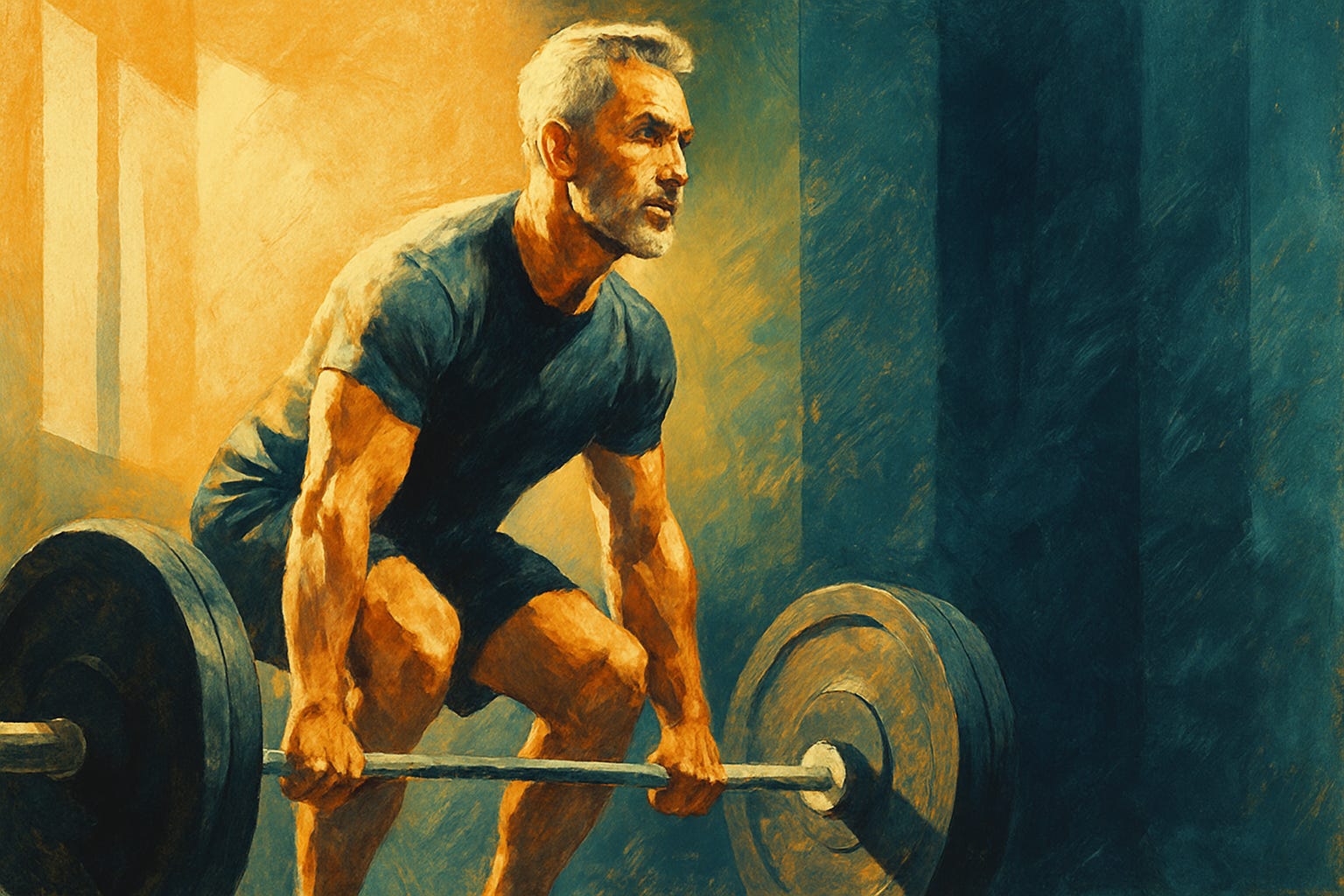
Somewhere around your 30th birthday, your testosterone started a slow, steady slide. Most research puts the decline at roughly 1 to 2 percent a year, and it doesn’t reverse on its own. By your mid-40s, that adds up to a noticeably different hormonal baseline than the one you had at 25, and the effects (less drive, slower muscle recovery, a libido that needs more convincing) are real even when a lab report calls your number “normal.”
We’re not here to sell you a $60 bottle of tribulus or convince you to book a TRT clinic. This is about what actually moves the needle in men who aren’t clinically hypogonadal: five habits with genuine research behind them, each one flagged honestly for how strong, or how shaky, that research really is. A couple of popular fixes barely survive contact with a randomized trial. Let’s get into it. 🧬
Lift heavy, and put the big lifts first
Resistance training is the single most consistent lever here, though the why is more complicated than most gym-bro folklore admits. A 2025 cross-sectional analysis in Frontiers in Physiology, using NHANES data on 4,495 men aged 20 to 59, found that men in the top quartile for testosterone had an 80 percent lower risk of low muscle mass than men in the bottom quartile. Worth being precise here: this is an observational study, not a trial, and testosterone tracked with muscle mass but showed no independent link to muscle strength. It tells us T and muscle travel together. It doesn’t prove lifting causes your T to rise.
For the causal piece, a 2026 systematic review in the Journal of Men’s Health pooled 20 human studies on training protocols and testosterone response, and the pattern held: heavy, compound lifts (squat, deadlift, press, row) done for multiple sets with short rest periods trigger a bigger acute hormonal response than isolation work or light weights. 💪 So if your session starts with fifteen minutes of curls, you’re leaving the strongest stimulus for last.
A few practical adjustments:
Open every session with one or two compound lifts, while you’re fresh
Work in the 70 to 85 percent of your max range for 3 to 4 sets
Keep rest between sets to 60 to 90 seconds on the big lifts
Train each major muscle group at least twice a week
Track load progression, not just soreness. Progressive overload is the actual stimulus, not fatigue
Add short, hard intervals twice a week
This one surprised us. A small 2017 trial published in Endocrine Connections put 17 masters athletes, average age 60, through nine high-intensity interval sessions (six 30-second sprints at 40 percent peak power, with 3-minute active recovery) spread across six weeks, layered onto six weeks of prior moderate cycling. Free testosterone rose. Total testosterone climbed too, from roughly 13.2 to 15.4 nmol/L over the full 12-week block, according to the research group’s published data.
Be honest with yourself for a second: when’s the last time your “cardio” was actually hard enough to count as a stimulus, rather than a podcast-listening stroll on the treadmill? 🔬 That said, this is a small study, n=17, in a specific population of previously sedentary older men, and it hasn’t been replicated at scale. We wouldn’t build a whole protocol around it. But it lines up with a broader physiological picture where brief, intense effort seems to signal the body differently than steady-state cardio does.
The caveat matters just as much as the finding: more isn’t better here. Chronic overtraining, especially long endurance blocks without adequate recovery, is a well-established way to suppress testosterone through elevated cortisol. Two 20 to 25 minute HIIT sessions a week, not five, seems to be where the sweet spot lives.
Sleep enough, but not too much
This is where the internet oversimplifies things. The famous data point, that skipping sleep can drop your T by 10 to 15 percent, comes from a small University of Chicago lab study of just ten healthy young men, average age 24, restricted to five hours a night for one week. It’s a real finding, but it’s not about men over 40, and n=10 is not a population you should build your bedtime around alone.
Zoom out to a larger 2023 NHANES analysis in the journal Andrology, covering 8,748 adults, and the picture gets more nuanced. Among men aged 41 to 64 specifically, sleeping 9 or more hours a night was associated with higher odds of low testosterone (OR 2.03) compared to 7 to 8 hours, not less sleep. 😴 Meanwhere, a 2021 meta-analysis of 18 studies (252 men total) found that short-term partial sleep restriction had no significant effect on testosterone in the pooled data; only total sleep deprivation of 24 hours or more reliably lowered it. Both are findings you can verify directly rather than take our word for.
So the honest takeaway is: consistency in the 7 to 8 hour range beats chasing either extreme, and sleep quality wasn’t independently linked to testosterone in the NHANES data either, which argues against obsessing over your sleep-tracker score. We’ve written before about the environmental side of this in our guide to optimizing your sleep setup, and it’s worth a read if your bedroom is working against you.
A few things that reliably help:
Keep a consistent wake time, even on weekends
Target 7 to 8 hours, not 6 and not 10
Cut caffeine after early afternoon
Get morning daylight exposure to anchor your circadian rhythm
Treat a training day and a five-hour-sleep night as a real deficit, not a wash
Lose the fat without losing the muscle
Here’s the mechanism, plainly: excess fat, especially visceral fat around the midsection, contains an enzyme called aromatase that converts testosterone into estradiol. More belly fat, more conversion, less circulating T. It’s a genuinely bidirectional trap, since low T also makes it easier to gain fat in the first place.
The data on fixing it is some of the strongest in this whole article. A large longitudinal cohort published in the International Journal of Obesity in 2024 found that for every kilogram of weight men lost over 36 months, total testosterone rose by 0.6 percent (p=0.002). Separately, a 52-week randomized controlled trial of 118 overweight and obese men, comparing high-protein and high-carbohydrate weight-loss diets, found testosterone and SHBG both rose significantly with weight loss, and the diet’s macro split didn’t matter. What mattered was the weight coming off, and interestingly, testosterone kept climbing during the 40-week maintenance phase, not just the initial 12-week loss phase. That’s a meaningful detail if you’ve ever quit a diet the moment the scale stalled.
Ask yourself honestly: is the number that’s actually suppressing your T the one on the bathroom scale, not the one on a supplement label? For men who are meaningfully overweight, that’s usually where the leverage is.
What the trial data suggests works:
A modest, sustained calorie deficit rather than a crash diet
1.2 to 1.6 g of protein per kilogram of bodyweight to protect lean mass
Resistance training kept in place during the cut, not paused
Patience through the maintenance phase, where gains kept compounding in the RCT above
Get honest about how much you drink
This is genuinely the most contested habit on the list, so we’re not going to pretend it’s simple. A small controlled crossover trial found that a single low-to-moderate dose of alcohol (about 0.5 g/kg, roughly two drinks) actually raised plasma testosterone within 90 minutes in healthy men, likely a byproduct of how the liver processes alcohol rather than anything beneficial. Acute and chronic effects are two very different stories.
Zoom out to a 2024 meta-analysis in Andrology covering 21 studies and roughly 10,199 subjects, and chronic heavy drinking is where the damage consistently shows up, driven largely by the liver’s role in metabolizing both ethanol and sex-hormone-binding globulin. The pooled evidence on this points toward heavy, sustained intake, not the occasional drink, as the actual problem. If you’re somewhere in the middle, honestly, the science doesn’t hand you a clean number. Most clinicians point to somewhere around 15 or more drinks a week as the zone where risk climbs.
Where this connects to the bigger picture: testosterone replacement therapy itself just went through a real regulatory shift. In February 2025, the FDA ordered class-wide label changes for all testosterone products, removing the decade-old boxed warning about cardiovascular risk after the TRAVERSE trial found no increase in major cardiac events among treated men, while adding a new warning about blood pressure. It’s a reminder that the TRT conversation is still actively moving, not settled science you can Google once and trust forever. The context that makes developments like this meaningful, who’s funding the trials, what the regulatory picture actually looks like now, is exactly what LongevityHub Pro was built to map for readers who want to track it closely.
None of that changes the lifestyle math above. It just means: fix the habits first, get bloodwork if symptoms persist despite fixing them, and treat any prescription decision as a conversation with a doctor who’s looked at your actual labs, not a headline.
So, of the five, which one are you actually neglecting right now? That’s probably the one to start with this week.