

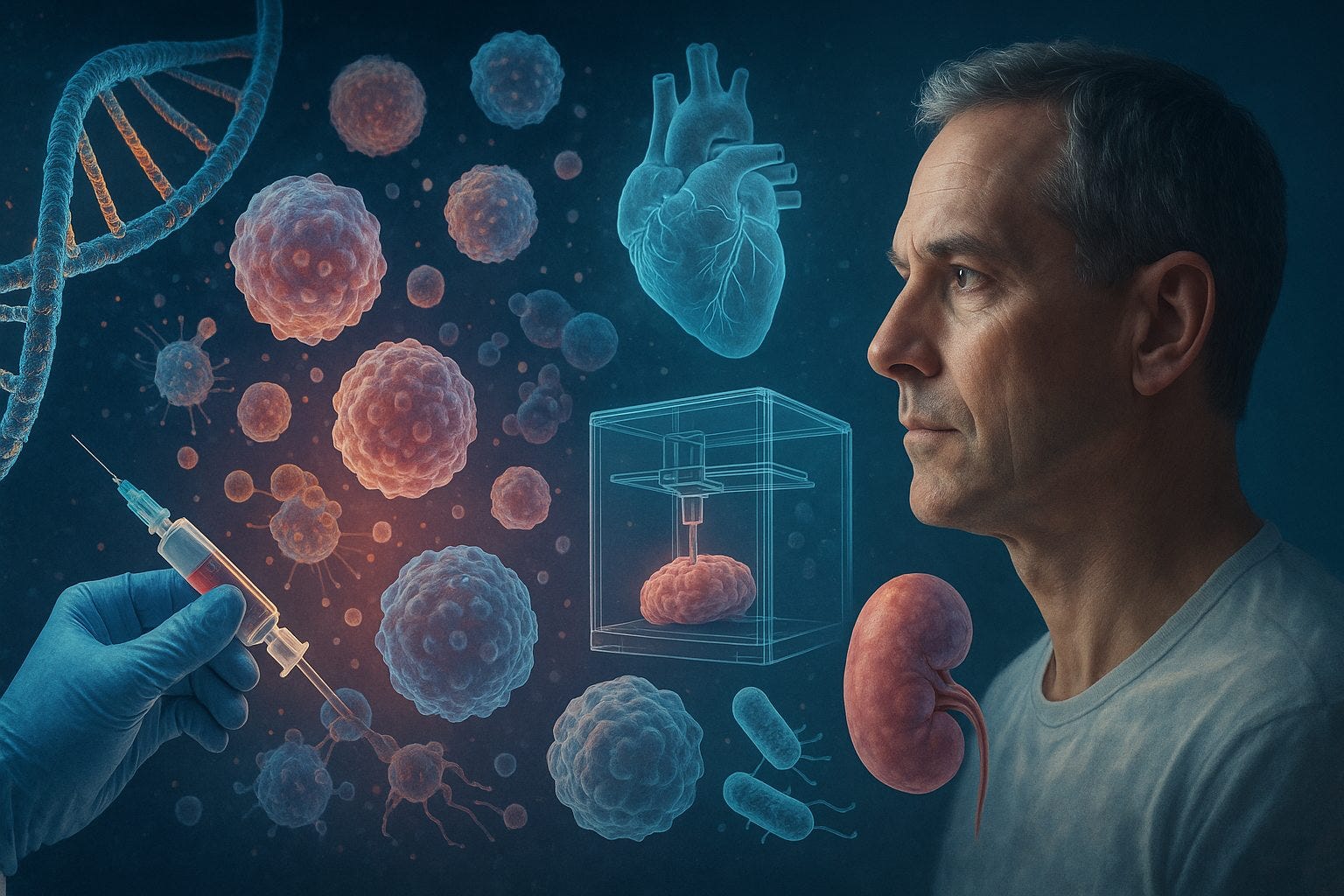
Imagine a future where a single injection fixes the DNA bug that once doomed someone to a lifetime of illness. A world where diabetes, sickle-cell crises, or even damaged hearts are cured — not just managed. That’s not science fiction. It’s the horizon doctors, researchers, and biotech companies are racing toward.
We stand now at a thrilling inflection point. The convergence of gene editing, cell therapy, AI-assisted treatments and bioengineering is creating an entirely new class of “once-and-done” cures. Some are already in early human trials. Others are being built in labs even as you read this — scaffolds, organoids, smart cells. By 2030, many of these could move from experimental to mainstream.
Below, I walk you through six of the most promising “futuristic” therapies likely to hit (or at least reshape) clinical care within the next five years or so. Buckle up.
1. Gene Editing Therapies (with CRISPR-Cas9 and beyond)
Gene editing is not new — but it’s getting scarily precise, fast, and real. The gene editing market is projected to hit over $10 billion by 2030.
Recent clinical trials show tangible wins. Blood disorders, inherited metabolic diseases, and other previously untreatable genetic maladies are now targets.
And it’s not just rare diseases: companies are working on base-editing (a gentler, more precise form of editing) for common conditions — like high cholesterol or heart disease — potentially making gene therapy relevant to millions.
If you thought “editing your genes” was for sci-fi movies, think again. Soon, it may be part of everyday medicine.
2. In-Body (In Vivo) Cell & Gene Therapies — No Transplant, All Magic
Traditional cell therapies often involve extracting cells, editing them in a lab, and reinfusing them. But the next generation aims to do that inside your body. That’s what researchers call “in-body,” or in vivo, therapies.
Why does that matter? Because it dramatically lowers complexity, cost, and time. Instead of weeks or months of lab work — you get an infusion or injection that does the job in your body. Faster, simpler, more scalable.
This could unlock treatments for chronic diseases (autoimmune diseases, diabetes, even heart disease) at population scale — not just rare disorders.
3. Advanced Cell Therapies: CAR‑T cell therapy 2.0 & Beyond
If traditional cancer therapies are blunt instruments, CAR-T is a sniper rifle. By reprogramming your own T-cells so they hunt cancer cells — boom — targeted destruction.
Thanks to improved gene-editing tools, newer CAR-T therapies may soon be safer, more effective, and more broadly applicable. One recent announcement describes a platform that uses CRISPR to systematically improve CAR-T cells for better tumor-killing performance.
But it doesn’t end there. AI is now helping design and predict safer, smarter CAR-T cells — potentially accelerating development cycles from years down to months.
By 2030, CAR-T may no longer be a niche last-resort for blood cancers — but a mainstream tool against a variety of cancers and even immune disorders.
4. Regenerative Medicine & Stem-Cell Therapies
What if you could regrow a damaged organ — or a chunk of failing tissue — instead of patching it up? That’s the bold promise of regenerative medicine.
Stem-cell therapies, bioengineered tissues, and “organoid” systems are pushing this dream closer to reality.
Think: heart tissue rebuilt after a heart attack, or damaged liver regenerated rather than transplanted, or even aging tissues renewed. Early-stage research shows we may be able to combine gene editing + stem cells + bioengineering for very precise, personalized regeneration.
It’s still early — but by 2030, regenerative medicine might feel like sci-fi come to life.
5. mRNA-Based Therapeutics — Not Just Vaccines Anymore
You know mRNA from COVID-19 vaccines. But that was just act one. The upcoming acts lean heavily into therapeutics.
mRNA delivery platforms are now being adapted to do gene editing and to deliver therapeutic payloads directly into your cells — without needing viral vectors.
That reduces the risk of immune reactions. It also speeds development. Bio-pharma firms now test hundreds of mRNA-based therapeutics for everything from metabolic diseases to rare genetic disorders.
By 2030, you might get mRNA treatments not just for viruses — but for chronic diseases, tissue repair, even gene correction.
6. Intelligent Antimicrobial & Cancer Therapies — Rewriting the Rules
Drug-resistant infections and aggressive cancers have long been two of the biggest threats in medicine. But emerging therapies promise to rewrite the rules.
For example, CRISPR-based antimicrobials — gene-editing tools that disable bacteria instead of killing indiscriminately — may finally give us a weapon against antibiotic-resistant “superbugs.”
In parallel: oncolytic viral therapies (viruses engineered to infect and kill cancer cells) combined with AI-driven prediction models might allow highly individualized cancer treatment. One recent AI model predicts how tumors + immune system + therapy will interact — guiding tailored regimens.
It’s not perfect. These therapies still face obstacles. But the trajectory is clear: smarter, more precise, more adaptive medicine.
What’s the Catch? (Because There Always Is)
I’m not selling magic beans. All of this progress carries risks and challenges. Gene editing can have off-target effects. Immune responses, regulatory hurdles, delivery challenges. Ethical questions. Cost and equity issues.
Also — pipeline consolidation and funding chills: biotech firms are narrowing their focus, prioritizing fewer therapies with faster return-on-investment.
Bottom line: not every promising therapy will make it. But many will.
Why This Matters — For You, For Society
Because this isn’t just about rare diseases or billion-dollar medical bills. It’s about fundamentally shifting how we treat health.
By 2030, medicine could be less about managing chronic conditions and more about curing them once and for all. Imagine the societal impact: less time in hospitals, fewer lifelong meds, better quality of life, reduced healthcare costs.
And for people like you and me — maybe a shot to fix genes, a pill-free course for diabetes, a bioengineered tissue patch instead of surgery.
Also read: 5 Longevity Treatments Coming to Your Doctor’s Office by 2030
So — What Should You Watch For?
Keep an eye on regulatory approvals: when gene-editing drugs start getting approved more widely, that will be the signal that things have shifted permanently.
Watch big-pharma moves: mergers, acquisitions, partnerships. If companies consolidate around a therapy, that’s often a fast track toward market release.
Check real-world data: long-term safety, effectiveness, cost, and equity (who gets access?).
Ask your doctor — for real. In five years, you might have choices you can’t even imagine now.
Curious about any one of these therapies in more detail — like how CAR-T 2.0 works, or which diseases are being targeted with mRNA editing? Just say the word. Let’s peek behind the curtain together 👨🔬