

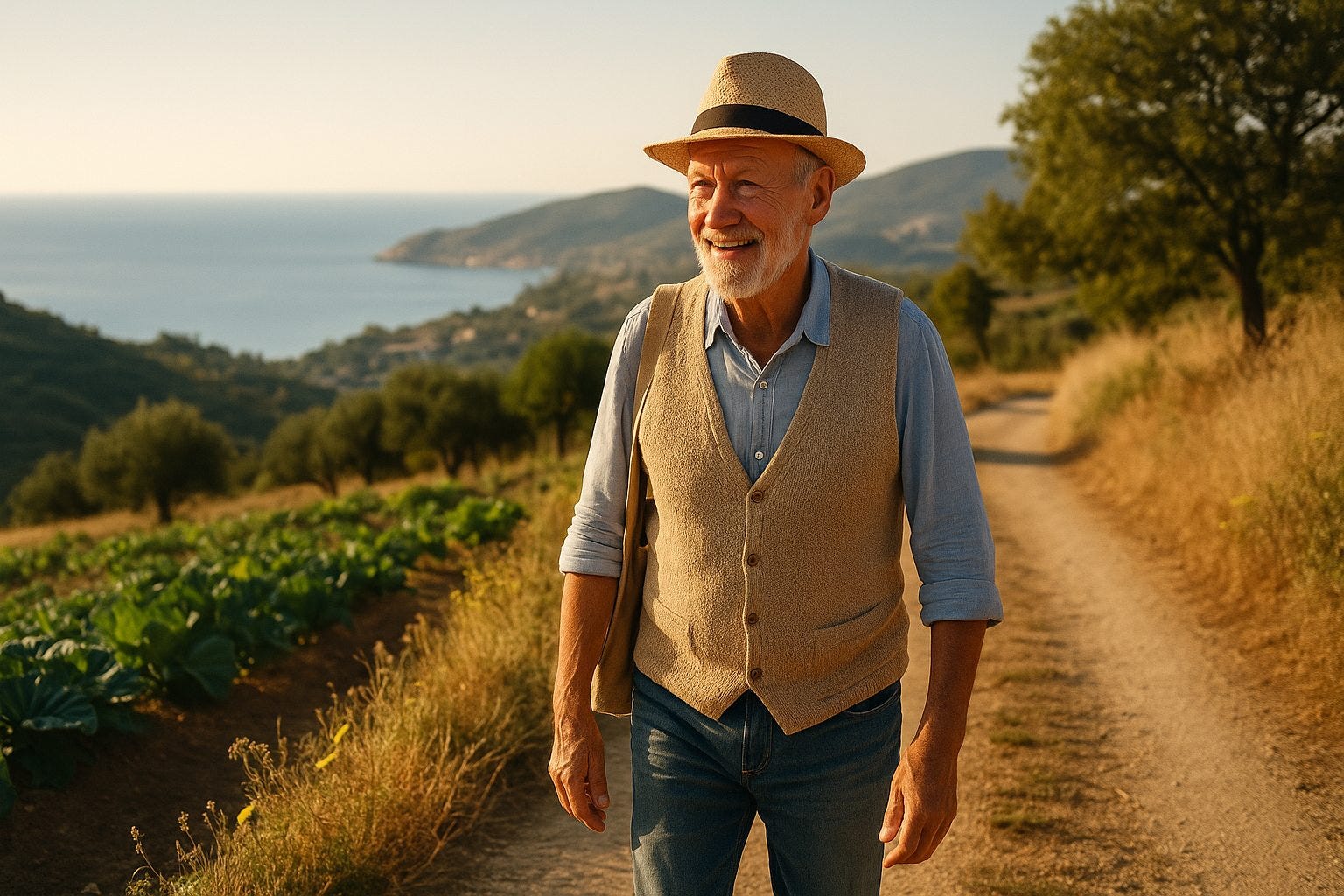
Imagine a place where it’s normal to meet people over 100 — active, alert, laughing with grandchildren or harvesting olives at sunset. Those places exist. They’re called Blue Zones: communities around the world where people consistently outlive global lifespans — not just narrowly, but by decades — often without chronic illness.
But these aren’t scientifically engineered utopias. No magic fountains. No genetic lottery jackpots. The secret is ordinary life. A rhythm of simple meals, gentle movement, meaningful connection, and rest.
In this article, I walk you through seven key lessons from Blue Zones — the kind you can begin weaving into your daily life. It’s not about copying a Greek village or an Okinawan town. It’s about borrowing their spirit. Let’s dive in. 😊
1. Move Naturally — skip the gym, just live
In Blue Zone communities, people don’t slog through hour-long gym sessions or lift weights for bragging rights. Instead, movement is woven into daily life. Think walking fields, tending gardens, climbing stairs, doing household chores, strolling to visit neighbors.
This kind of low-key, constant motion adds up. It keeps muscles active, joints supple, circulation flowing, and burns off extra energy — without stress, strain, or scheduling a “workout hour.”
💡 Takeaway: Try to weave light activity into your day: walk instead of drive, take the stairs, garden, stretch during calls. It works.
Related: 6 Small Movement Hacks That Keep Your Cells Young
2. Eat with Intention — not to burst, but to nourish
Centenarians in Blue Zones don’t obsessively count calories. Instead, they follow a principle called the Hara Hachi Bu — “eat until you’re 80% full.” Early dinner — often the smallest meal of the day — and enough space between meals to let the body rest.
Their plates lean heavily plant: beans, legumes, whole grains, vegetables, leafy greens, nuts, seeds, occasional fish or modest meat portions. Processed foods, refined sugars, and heavy animal fats stay rare.
🌿 Takeaway: Slow down. Eat more plants. Let your body tell you when to stop.
Related: 6 Foods Longevity Scientists Eat Every Week (And Why You Should Too)
3. Let Purpose Pull You Forward — “Why get up in the morning?”
In many Blue Zones, people have a guiding sense of meaning — a reason to rise each day. In Okinawa it’s called Ikigai, in Nicoya (Costa Rica) it’s Plan de Vida.
Whether that purpose comes from tending a garden, helping grandkids, volunteering, staying active in a faith community, or simply cherishing daily rituals — it roots you. Gives you a reason to resist emptiness. Keeps the mind sharp, mood stable, spirit engaged.
💡 Takeaway: Ask yourself — what makes you want to hop out of bed? Write it down. Treat it as sacred.
Also read: 7 Morning Habits That Switch On Your Longevity Genes
4. Build a Circle That Holds You — community matters
Blue Zone folks don’t rely on isolation. Their lives are threaded with social bonds: family dinners, community gatherings, intergenerational homes, friendships, support groups.
In some places, they form lifelong support circles — like the Okinawan Moai — a tight-knit group that provides emotional, social, often financial support across decades.
These connections do more than warm the heart. They reduce stress, improve mental health, lower risk of depression — all crucial for long-term well-being.
🤝 Takeaway: Don’t ghost your people. Call a friend, eat dinner with family, join a group, volunteer — build your Moai.
5. Downshift — manage stress before it manages you
Life in Blue Zones is slower. People don’t hustle from meeting to meeting. They “downshift.” They rest. They nap. They pray or meditate. They reconnect with loved ones and their surroundings.
This ebb-and-flow rhythm — activity balanced by calm — helps tamp down chronic stress, which, left unchecked, churns inflammation, weakens immunity, and speeds aging.
🌙 Takeaway: Create your own downshift ritual — a quiet walk, an evening without screens, a short meditation, a proper rest. Your body (and mind) will thank you.
Related: 6 Quick Mindset Shifts To Reduce Stress and Add Years to Your Life
6. Make Moderation Your Mantra — especially with food, drink, and indulgence
Blue Zone wisdom rarely entertains extremes. Meals are moderate, portions modest, treats occasional. Even in the handful of zones where alcohol appears — it’s used with restraint, ritual, and usually alongside food and friends.
Moderation creates space. Space for balance, flexibility, and consistency. It’s sustainable over decades.
⚖️ Takeaway: Forget crash diets. Skip all-or-nothing thinking. Lean into moderation.
7. Let Nature Be Your Gym, Kitchen, and Sanctuary
The environment in Blue Zones — and mentality toward it — matters. People often live close to nature: walking paths instead of highways, gardens instead of concrete yards, seasonal food grown and harvested locally, nature-accessible lifestyles.
They also use nature to ground themselves: growing food, walking outside, breathing fresh air, living close to community. That deep bond with the natural world — simple, real, unfiltered — fosters peace, sense of belonging, and physical vitality.
🍃 Takeaway: Bring a touch of green into your life. Walk in a park, plant something, eat seasonal produce, watch the sky — let the planet nurture you back.
Why These Lessons Still Matter — even now
We live in a world that glorifies extremes: intense workouts, strict diets, productivity hustle, fast fixes, “biohacks.” But what Blue Zones show us is that longevity doesn’t require hype. It requires harmony.
It’s not about pushing limits. It’s about gentle rhythms, solidarity, balance, and respect for our bodies and communities.
Even though the Blue Zones concept originally relied on geography and a degree of isolation, many parts of the world today — even cities — can borrow those lessons. Because these aren’t just habits. They’re choices.
And choice — that’s power.
Also read: 7 Longevity Myths That Are Holding You Back (Debunked by Experts)
What Could You Try Tomorrow?
Wake up. Ask: Why am I getting out of bed? Write down your “Ikigai.”
Walk somewhere on foot — even if it’s just to buy groceries.
For dinner, plate a big salad or a bean-lentil dish. Stop at 80%.
Call a friend or family member. Share a meal or a laugh.
Take 10 minutes to sit in silence or stretch — no screens, no alerts.
Plant something. Watch a tree or herb grow. Feel part of something bigger.
Start small. Pick one of these. Then maybe another. In a few months — heck, a few years — you might find yourself living not just longer, but richer.
Because longevity isn’t a sprint. It’s more like a gentle, enduring stroll.