

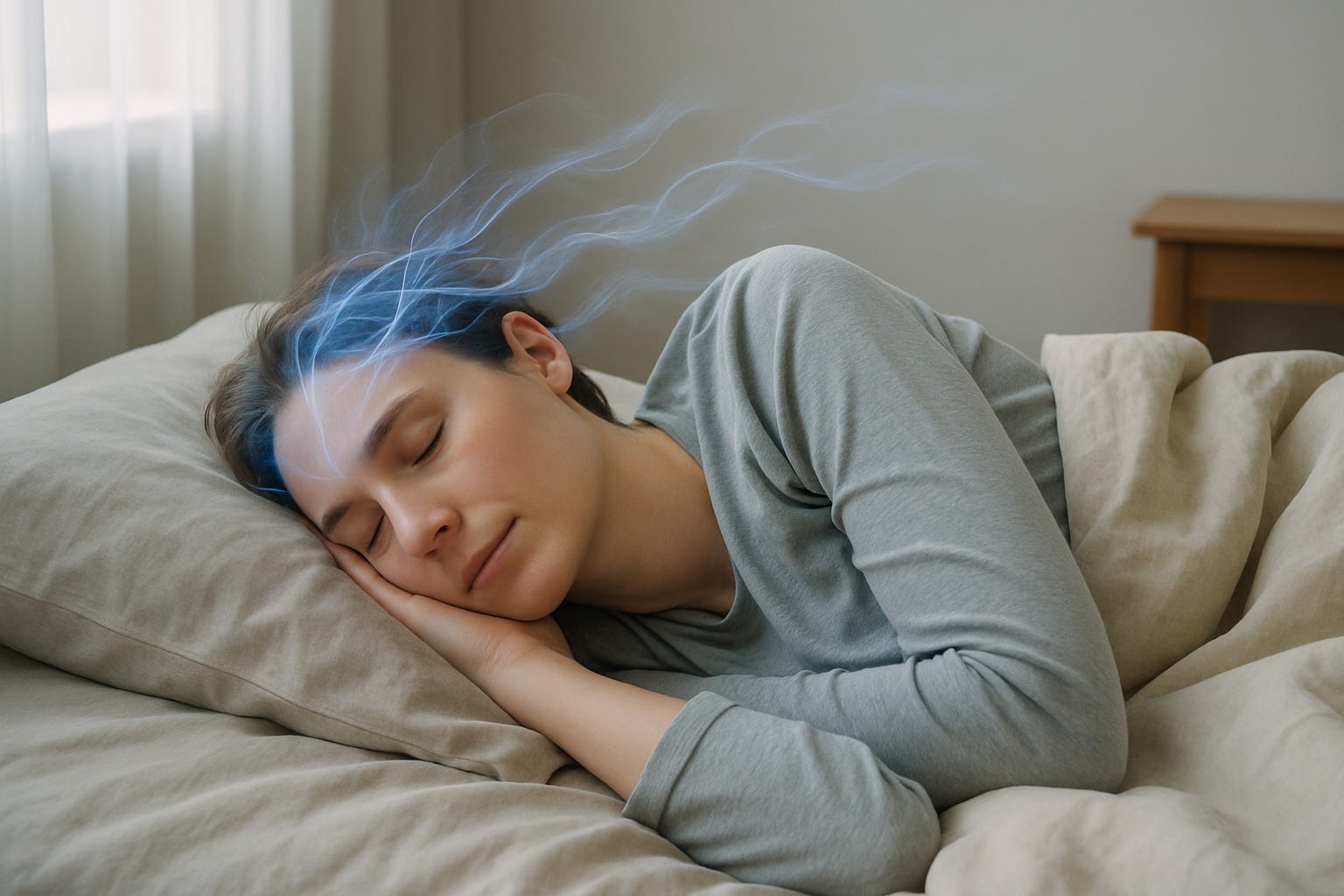
You already know sleep matters. What you probably do not know is that your brain runs an actual plumbing system at night, one that flushes out the metabolic junk your neurons produce all day. 🧠 It is called the glymphatic system, and it barely existed in scientific conversation before 2012. Now it might be one of the most important things you can do for your long-term brain health, and it hinges on a single sleep stage most of us are quietly shortchanging.
I am talking about deep sleep, also known as slow-wave sleep. Not just any sleep, and not more screen time in bed hoping to “catch up.” Here is what the glymphatic system actually does, why deep sleep is the stage that switches it into high gear, and what the research says you can do tonight to get more of it. 💧
The brain’s clean-up crew that nobody had named until 2012
For decades, neuroscientists assumed the brain quietly recycled its own waste with no dedicated drainage system, unlike the rest of the body, which relies on the lymphatic system to haul away cellular debris. That assumption fell apart in 2012, when Maiken Nedergaard and her team at the University of Rochester described a network of channels running alongside the brain’s blood vessels, publishing their findings in Science Translational Medicine. 🔬
The system works by pumping cerebrospinal fluid through brain tissue, washing away metabolic waste, including proteins like beta-amyloid and tau that are strongly linked to Alzheimer’s disease. Researchers gave it the name glymphatic, a mashup of “glial” and “lymphatic,” since the channels are built and maintained by glial cells rather than the lymph vessels found elsewhere in the body. Some scientists have taken to calling it the brain’s night shift cleanup crew, and honestly, that nickname does more explanatory work than most textbook definitions. 🧼
What makes this more than a neat anatomy fact is timing. The glymphatic system does not run at a constant rate all day. It ramps up dramatically during sleep, and specifically during one stage of it.
Deep sleep is the shift when the clean-up crew actually clocks in
Sleep is not one uniform state. You cycle through light sleep, deep sleep (slow-wave sleep), and REM sleep multiple times a night, and each stage does different work. Deep sleep is the stage where brain waves slow into long, rolling delta patterns, and it is also when glymphatic flow appears to accelerate the most. 😴
Researchers at Duke University‘s Pratt School of Engineering used a new imaging technique in 2026 to track this fluid movement directly, and found two distinct speeds: a faster flow through open channels near the brain’s surface, and a slower flow, roughly 50 times slower, through deeper tissue. One of the study’s engineers, Junjie Yao, noted that when animals were put under anesthesia instead of allowed to sleep naturally, waste clearance did not improve the same way, which suggests real sleep is doing something anesthesia cannot fake. 🌊
Have you ever assumed sleep is sleep, as long as you get enough hours? I used to think that too. But a separate study from the University of Washington School of Medicine found that glymphatic activity does not simply switch on during deep sleep and off during waking, as earlier rodent research suggested. In humans, it stayed active through both deep and REM sleep, then gradually accelerated the longer someone stayed asleep before slowing as they woke up. Sleep science keeps getting more precise here, and less like a light switch, more like a dimmer.
This isn’t just a curiosity, it’s tied to Alzheimer’s risk
Here is where the stakes get real. A 2026 randomized trial published in Nature Communications tracked 39 participants overnight and found that normal sleep, compared with sleep deprivation, changed the levels of Alzheimer’s-linked biomarkers showing up in blood plasma the next morning, offering some of the first direct human evidence that glymphatic clearance is doing exactly what animal studies predicted. 🧬
The longer-term data lines up with this. A 2020 meta-analysis in JAMA Neurology, pooling more than 31 studies and over 97,000 participants, found a U-shaped relationship between sleep duration and dementia risk, meaning both short sleepers and unusually long sleepers fared worse. Framingham Heart Study data published in Neurology back in 2017 found that short sleepers faced nearly double the dementia risk over a decade of follow-up compared with people getting adequate sleep. 📊
I want to be honest about a limitation here, because it matters: none of this proves sleep loss causes dementia in a clean, one-directional sense. Early-stage dementia can itself disrupt sleep, muddying which came first. Still, the mechanism is plausible enough, and consistent enough across independent research groups, that treating deep sleep as optional starts to look like a bad bet. ⚠️ We have written before about how poor sleep appears to accelerate brain aging on its own, separate from the glymphatic angle, and the two lines of evidence point in the same uncomfortable direction.
How to actually get more deep sleep tonight
The frustrating part about deep sleep is that you cannot will yourself into it directly. You can only build the conditions that make it more likely. Most adults get somewhere between 10 and 15 percent of total sleep time in this stage, and that share tends to shrink with age, stress, alcohol, and irregular schedules. 🌙
A few changes with real evidence behind them:
Keep a consistent bedtime and wake time, even on weekends, since irregular sleep timing appears to disrupt slow-wave sleep specifically
Get 20 to 30 minutes of morning sunlight, which anchors the circadian rhythm that governs when deep sleep shows up
Keep the bedroom cool, somewhere around 65 to 68°F, since core body temperature needs to drop for deep sleep to kick in
Finish exercise a few hours before bed rather than right before it, since late intense workouts can raise cortisol and delay deep sleep onset
Cut back on evening alcohol, which fragments sleep architecture even when it makes falling asleep feel easier
Have you ever checked how much deep sleep you are actually getting, versus how much you assume you are getting? A lot of people are surprised. If you already use a sleep tracker, that number is worth more attention than your total hours in bed. For a fuller routine, we broke down five science-backed tricks for boosting cellular repair during sleep that pair well with the habits above. 💡
The takeaway: treat deep sleep like a non-negotiable
None of this requires new technology or a subscription. The glymphatic system runs on a stage of sleep your brain already knows how to produce, provided you give it a consistent schedule, a cool dark room, and a nervous system that is not still running on cortisol from a late workout or a doomscroll session. We have covered the full case for treating recovery as a serious longevity lever if you want the broader picture beyond sleep alone. 🌱
If you want to read the primary research yourself, Wikipedia’s overview of the glymphatic system is a reasonable starting point, and the University of Washington’s own summary of its glymphatic imaging study lays out the human findings in plain language.
So, what time did you actually fall into deep sleep last night? If your honest answer is “I have no idea,” that is probably the first thing worth finding out before you spend another dollar on a supplement aimed at the same goal. 🛌