

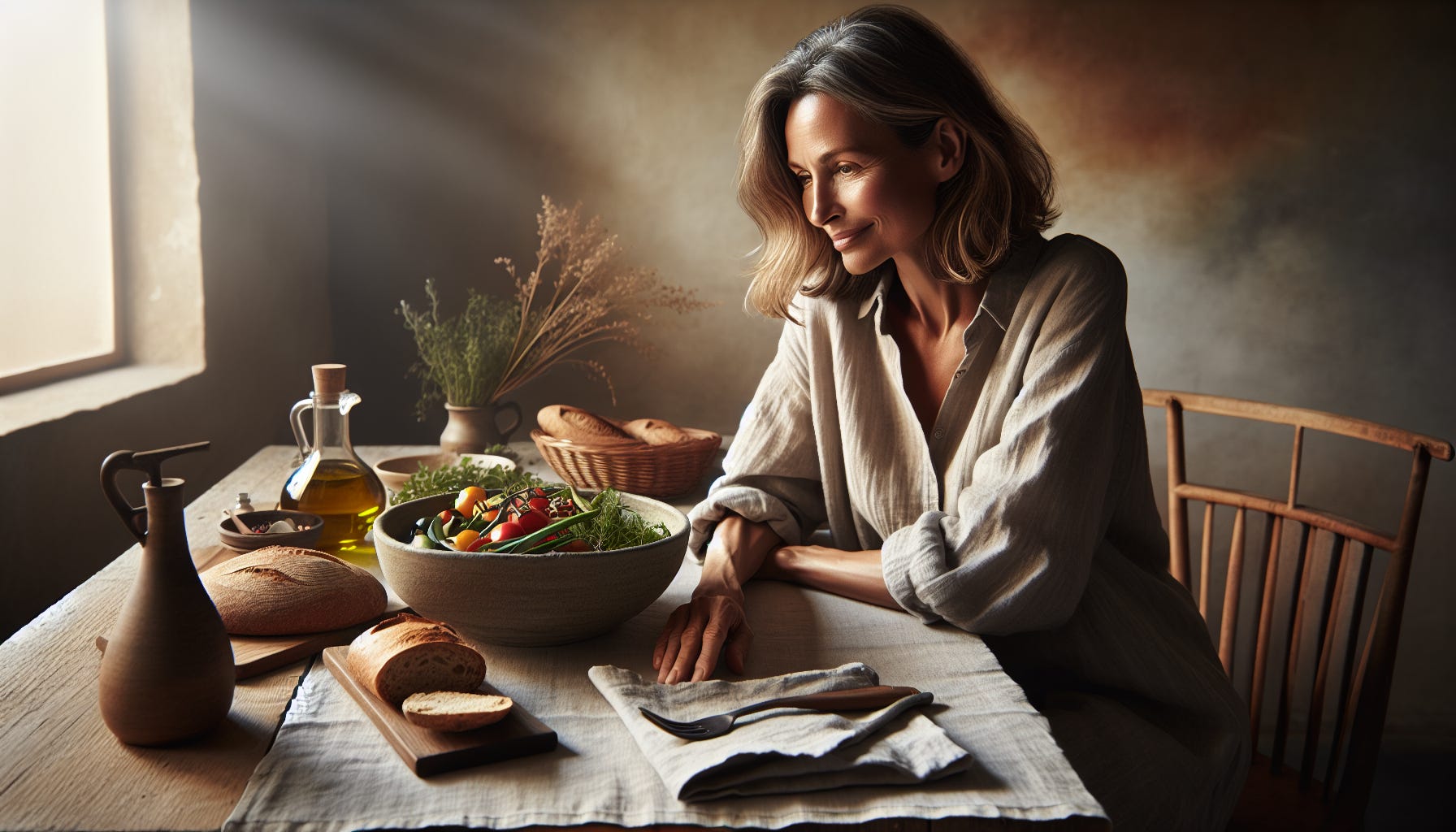
Here’s what nobody tells you about eating for longevity: the people who live the longest don’t count calories, don’t follow rigid macros, and didn’t grow up reading nutrition labels. The centenarians of Okinawa, Sardinia, and Ikaria weren’t optimizing their diets. They were just eating the food that had been around them their whole lives — mostly plants, a little fish, a lot of olive oil, and plenty of meals shared with people they actually liked. And somehow, they kept outliving the rest of us.
The good news? Modern science has spent the last two decades reverse-engineering exactly what they were doing. The emerging picture is equal parts reassuring and practical: eating well for a longer life is not about sacrifice. It’s about subtraction in a few specific places, and abundance almost everywhere else. You probably don’t need to give up bread. You almost certainly don’t need to go vegan. And the glass of wine is still being debated. What the evidence does say, though, is worth paying close attention to.
The science is clearer than it’s ever been 🔬
For most of nutritional history, researchers argued about individual nutrients — fat, carbs, protein, cholesterol — as if the body experienced each one in isolation. It doesn’t. It experiences food. Meals. Patterns. And that shift in thinking has completely changed what we know about eating for a long life.
A landmark analysis of data from more than 100,000 people in the UK, tracked over several years, found that participants whose diets scored high across any of five healthy dietary patterns were 18 to 24 percent less likely to die of any cause than those who scored lowest. The five diets were wildly different in their details, but they all shared a core structure: lots of fruits and vegetables, healthy fats, whole grains, and minimal processed foods. As Liangkai Chen, an associate professor at Huazhong University of Science and Technology and lead author of the study, put it, “The secret to a longevity diet is not about finding the one magical formula.”
That might feel anticlimactic if you were hoping someone would hand you a sacred list of twelve foods. But it’s actually liberating. The science says there are multiple paths. What matters is the general direction.
Dr. Frank B. Hu, a professor of nutrition and epidemiology at the Harvard T.H. Chan School of Public Health, is pretty direct about this: “There is no rigid type of diet that everyone should follow to live longer and healthier,” he told CNBC. He suggests treating longevity nutrition like building a personal “fusion diet” — identify the whole foods you genuinely enjoy, then arrange them into a daily pattern. Adherence is everything, and nobody sticks to food they hate.
Key things the best-performing dietary patterns have in common:
Heavy emphasis on vegetables, fruits, and whole grains
Legumes (beans, lentils, chickpeas) as a daily staple
Nuts and seeds eaten regularly, not sparingly
Healthy fats — especially from olive oil — over industrialized seed oils
Minimal ultra-processed foods and sugary drinks
What’s notably absent from that list: specific prohibitions on foods most people enjoy. Moderate amounts of fish, eggs, some dairy, even occasional lean meat fit into most of these patterns without wrecking the outcome. The obsession with “clean eating” — with its long lists of banned items — is mostly noise.
The ultra-processed food problem is real and urgent ⚡
If there is one area where the evidence has become genuinely alarming, it’s here. A 2025 meta-analysis of 18 studies covering more than 1.1 million participants found that people in the highest tier of ultra-processed food consumption had a 15% higher risk of all-cause mortality compared to those who ate the least. Every 10% increase in ultra-processed food consumption was associated with a 10% jump in mortality risk. Linear. Dose-dependent. Hard to explain away.
For context, Dr. Hu notes that in the United States, almost 60% of daily calories come from ultra-processed foods — things like soft drinks, packaged snacks, and pre-made frozen meals. The numbers are similar in the UK, Canada, and Australia. That’s not a minor dietary indulgence; it’s the structural foundation of how most people eat.
The mechanism isn’t fully settled, but researchers point to a few converging factors:
Hyperpalatability: Ultra-processed foods are engineered to override your satiety signals, making overconsumption almost automatic
Nutrient displacement: They crowd out whole foods that contain fiber, polyphenols, and other compounds actually associated with longevity
Chemical load: Emulsifiers, artificial colorings, and preservatives may disrupt the gut microbiome in ways that compound over decades
Inflammation: Chronic low-grade inflammation — “inflammaging,” as researchers are starting to call it — is driven in part by consistent consumption of highly processed ingredients
A Lancet multicentre study of 428,728 participants across nine European countries, published in January 2025, found ultra-processed foods associated with higher mortality not just from all causes, but specifically from cardiovascular disease, cerebrovascular disease, and even Parkinson’s disease. The researchers’ conclusion was blunt: replacing ultra-processed foods with minimally processed alternatives was associated with meaningfully lower mortality risk.
This doesn’t mean every packaged food is dangerous. A bag of plain frozen peas is processed in a technical sense. What matters is the NOVA classification framework: industrial formulations made largely from substances extracted from food, with additives designed to make them hyper-palatable. If you can picture the ingredient in a field or a kitchen, it’s probably fine. If it reads like a chemistry textbook, it probably isn’t.
What can you do today? Honestly, the shift doesn’t have to be dramatic. Think about swapping three or four items per week: replace the sugary breakfast cereal with oatmeal you cook yourself; swap the diet soda for sparkling water with citrus; trade the processed deli meat for canned sardines or a handful of walnuts at lunch. Small, consistent, boring — that’s how longevity nutrition actually works. 🌱
Beans are the closest thing to a superfood that actually exists 🧬
There’s a running joke in longevity research that if you boil down the Blue Zones data to one food, you get beans. The Blue Zones research, compiled from dietary surveys of the world’s longest-lived populations, found that legumes are the cornerstone of every longevity diet in the world — black beans in Nicoya, lentils and garbanzo beans in the Mediterranean, soybeans in Okinawa. The recommended intake is at least half a cup of cooked beans per day.
And honestly, once you stop thinking of beans as deprivation food and start thinking of them as flavor vehicles — capable of absorbing spices, olive oil, garlic, and herbs in ways that chicken breast can only dream about — the whole proposition changes.
But it’s not just beans. The evidence for dietary diversity is becoming one of the more interesting threads in longevity science. Research by Liao and Li, published in Frontiers in Medicine in 2024, found that eating a wider variety of foods delays biological aging — the actual functional age of your cells, which is distinct from your chronological age. Consistently consuming over 30 different types of plants per week creates a more robust gut microbiome, which in turn reduces the chronic, low-level inflammation that drives most age-related disease.
Think about what that actually means for how you eat. It’s an argument for variety over optimization. It says: stop eating the same five vegetables on rotation and start treating the produce section as a challenge. Purple cabbage and white cabbage don’t count as two different plants in spirit, even if technically they do. The goal is genuine diversity — different colors, different textures, different plant families.
The specific foods worth thinking about as longevity anchors:
Leafy greens (spinach, kale, chard, collards) — the Blue Zones data flags these as the single best longevity foods
Nuts, especially walnuts, almonds, and pistachios — the Adventist Health Study found nut eaters outlive non-nut eaters by an average of two to three years
Olive oil — both the Mediterranean Blue Zones and the broader Mediterranean diet literature point to extra virgin olive oil as a key factor in cardiovascular protection
Whole grains — fiber intake has a “strong association with longevity” across multiple studies, and whole grains are the most practical source
Does any of this require giving up meat entirely? Almost certainly not. The longest-lived communities in Sardinia and Nicoya ate small amounts of meat regularly. What they didn’t do is eat it three times a day. The adjustment isn’t elimination — it’s proportion.
What Dr. Valter Longo gets right about timing 💊
Dr. Valter Longo, the Italian-American biogerontologist who directs the Longevity Institute at USC, has probably done more than anyone to shift the conversation from what you eat to when and how you eat it. His research on the fasting-mimicking diet (FMD) — a five-day cycle of low-calorie, plant-based eating designed to trigger the body’s cellular repair processes without the misery of water-only fasting — has produced some of the most compelling longevity data in recent years.
A 2024 study published in Nature Communications found that people who completed FMD cycles showed measurable reductions in biological age — based on validated epigenetic clock measurements — alongside improvements in immune function and metabolic markers. “This is the first study to show that a food-based intervention that does not require chronic dietary or other lifestyle changes can make people biologically younger,” Longo said.
But what’s more accessible than the FMD for daily life is Longo’s guidance on time-restricted eating. He recommends confining all food intake to an 11- to 12-hour window each day — which for most people just means eating breakfast no earlier than 8 a.m. and finishing dinner by 7 or 8 p.m. That’s it. No calorie counting. No food restrictions. Just a window.
Research from the Salk Institute supports this approach, finding that a 10-hour eating window boosts stem cell regeneration even without any reduction in calories. The mechanism involves letting insulin levels drop fully overnight, allowing cellular repair processes — particularly autophagy, the cellular “cleaning” system — to run uninterrupted.
On protein: Longo’s position is nuanced and worth understanding. For people under 65, he recommends relatively low protein intake — roughly 0.68 to 0.79 grams per kilogram of body weight — because high protein intake activates mTOR, the cellular growth pathway that, when chronically elevated, appears to accelerate aging. After 65, the calculus shifts: sarcopenia (muscle loss) becomes a real risk, and protein intake from fish, eggs, and white meat should increase. It’s an interesting exception to the “less protein is better” mantra, and one the research genuinely supports.
Have you ever experimented with time-restricted eating — even casually? The evidence suggests the timing window may matter as much as what’s inside it.
The 80/20 principle that actually saves you 🌿
Here’s where most longevity nutrition advice falls apart: it treats every meal as a test. It creates anxiety around food that is, in its own right, bad for your health. Chronic stress — including the kind generated by obsessive dietary restriction — raises cortisol, suppresses immune function, and, ironically, accelerates biological aging. So the framework matters.
The way Dr. Hu frames it is probably the most honest and practical framing in the field: build a diet you genuinely enjoy, because long-term adherence is the only thing that actually moves the needle. People who successfully eat for longevity don’t white-knuckle their way through every dinner party. They’ve built a default pattern that’s mostly plants, mostly whole foods, mostly cooked at home — and then they don’t stress when that pattern breaks for a birthday, a holiday, or a really excellent plate of pasta.
The Blue Zones lessons we’ve covered on LongevityHub make this point another way: the communities with the longest lives didn’t experience food as medicine. They experienced it as pleasure, culture, and connection. Meals were social events. Ingredients were local and seasonal. Cooking was a daily practice, not a chore done reluctantly on Sunday nights for the week ahead.
Some genuinely useful principles for making this sustainable:
Cook most of your own food — not because restaurants are evil, but because home cooking almost automatically reduces ultra-processed ingredient exposure
Build in intentional flexibility — if you know Saturday dinner might involve a burger or a dessert, don’t treat it as a failure. It isn’t one
Replace before you eliminate — instead of “I can’t have chips,” try “I’ll have roasted chickpeas first and see if I still want the chips.” Often you won’t
Eat with people — the social dimension of meals isn’t a soft benefit. It’s consistently associated with better dietary choices and lower mortality
A 2025 Lancet analysis estimated that adopting Blue Zones eating habits at age 60 still adds an average of eight healthy years. Not eight years in a hospital bed — eight years of functional, active living. That’s the actual goal, and it’s achievable without turning your kitchen into a laboratory or your life into a joyless optimization project.
The real question isn’t what you need to give up. It’s what you need to add. More beans, more variety, more olive oil, more meals eaten slowly with people you care about. That’s not deprivation. That’s just a better way to eat. What’s one food you already love that also happens to be genuinely good for your longevity — and could you find a way to eat more of it, starting this week?