

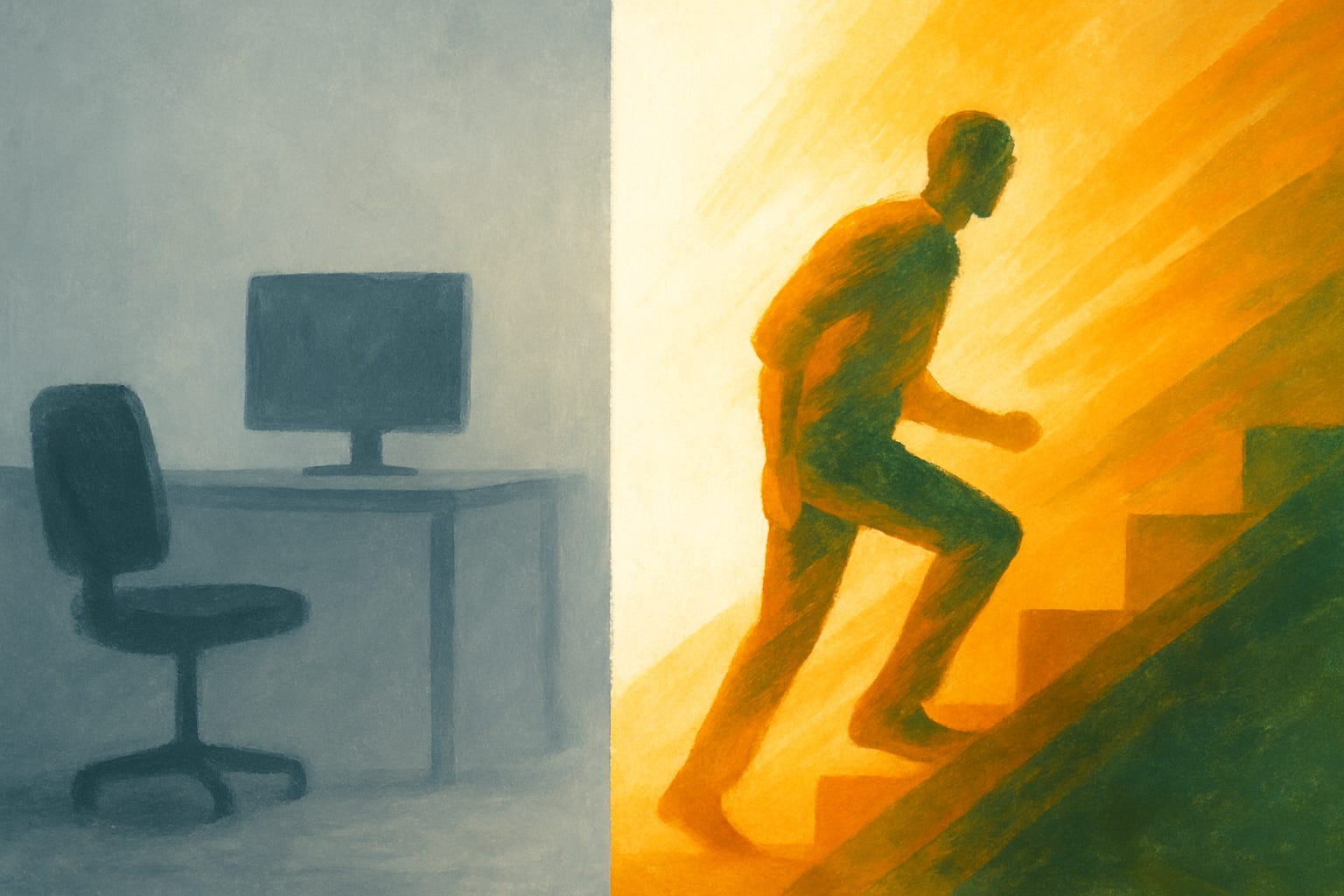
Roughly 80% of jobs in the US now qualify as sedentary or low-activity, up 83% over the past 50 years. That’s not a lifestyle choice most of us are making. It’s the shape modern work has taken, and your body, evolutionarily speaking, has no idea what to do with eight hours of sitting followed by a commute followed by a couch. 🪑 Mayo Clinic’s own overview of sitting risks puts it plainly: prolonged sitting raises the risk of death from heart disease and cancer, regardless of what you do outside those hours.
Here’s the part that should worry you more than it probably does: your evening workout doesn’t cancel this out. 🔬 We looked at what the actual randomized trials, cohort studies, and meta-analyses say about surviving a desk job without quietly shortening your life, and the honest answer involves less equipment and more timing than the wellness industry tends to admit.
Why your gym membership doesn’t cancel out your chair
Researchers have a name for this: the active couch potato effect, and it’s backed by more than a hunch. A 2024 study in the Journal of the American College of Cardiology used wrist-worn accelerometers, not self-reports, to track sedentary time and found that once daily sitting crosses roughly 10.6 hours, cardiovascular mortality risk climbs by 40 to 60%, and this held true independent of whether participants met physical activity guidelines. 🧠 Hitting your 150 minutes of weekly exercise is genuinely good for you. It just isn’t a receipt you can use to refund the other 14 waking hours.
A separate 2024 analysis in JAMA Network Open, led by researcher Wenjing Gao, examined occupational sitting time specifically (not leisure sitting) and found it independently predicted cardiovascular mortality, distinct from how people spent their time off the clock. 🔬 The mechanism isn’t mysterious once you look at it: in a controlled lab setting, blood flow through the popliteal artery behind the knee dropped from a healthy 7.1% to 2.8% after just three hours of uninterrupted sitting, a shear-stress effect on the blood vessel lining that starts within a single workday, not over years. ⚡
What this actually means for a desk job:
Your body treats occupational sitting and leisure sitting as two separate risk exposures, not one shared bucket
A hard workout at 6 a.m. doesn’t neutralize an unbroken 9 a.m. to 5 p.m. sit
The mortality risk shows a real threshold around 10 to 11 hours a day, not a smooth line, so where you land matters
Interrupting sitting, not just reducing total hours, appears to be doing most of the protective work
Have you ever actually timed how long you sit without standing during a normal workday? Most people guess low. It’s worth checking once, honestly, before assuming your situation is fine.
The standing desk myth nobody wants to hear
This is the section that annoyed us most while researching it, mostly because we own a standing desk. 😅 A 3-month randomized clinical trial called RESET-BP, published in Circulation in 2024, recruited desk workers with untreated elevated blood pressure and had them replace roughly one hour a day of sitting with standing and light stepping, using a sit-stand desk plus coaching. The result: no improvement in blood pressure or arterial stiffness. More strikingly, greater time spent standing at work was actually associated with increased central arterial stiffness, a marker tied to cardiovascular risk, even as diastolic blood pressure showed a small benefit.
That’s not a fluke. 🧠 A large, device-measured observational study covered by CNN in late 2025 tracked over 83,000 adults and found that while sitting more than 10 hours a day raised heart disease and stroke risk, simply standing more didn’t reduce that risk, and prolonged static standing was linked to a higher risk of circulatory problems like varicose veins. Separately, a Cochrane systematic review of 20 workplace studies covering more than 2,000 employees concluded there’s currently only low-quality evidence that sit-stand desks even reduce sitting time long-term, let alone improve health outcomes. 📉
We want to be fair to the desk itself here: it’s genuinely useful for interrupting long static stretches, and workers who used them did log 30 minutes to 2 hours less sitting per day in some studies. The mistake is treating standing as the therapeutic ingredient. It isn’t. Movement is, and standing still at a raised desk is, physiologically, just a different flavor of static.
A sit-stand desk is a tool for triggering position changes, not a passive cardiovascular fix on its own
Static standing for long stretches carries its own circulatory downsides, including pooling blood in the legs
If you own one, set it to alternate on a timer rather than defaulting to “standing all afternoon”
The evidence gap here is real. Cochrane reviewers explicitly called for larger, longer trials before drawing firm conclusions
The exact walking dose the data landed on
If standing isn’t the lever, what is? A small but tightly controlled Columbia University study, led by Dr. Keith Diaz and published in Medicine & Science in Sports & Exercise in 2023, tested five different “activity snack” schedules on 11 adults sitting for 8-hour lab sessions. ⚡ The winner, and the only schedule that meaningfully improved both blood sugar and blood pressure, was 5 minutes of light walking every 30 minutes. It cut post-meal blood sugar spikes by 58% compared with sitting all day and dropped blood pressure by 4 to 5 mmHg, a reduction Diaz compared to what you’d expect from six months of daily exercise. The sample is small, worth saying plainly, but it’s a randomized crossover design, so each person served as their own control across conditions.
The broader “exercise snacks” literature backs the general idea even if the exact dose varies. 🔬 A 2025 meta-analysis pooling 11 randomized controlled trials and 414 sedentary or inactive adults found that brief bouts of moderate-to-vigorous activity, mostly stair climbing lasting five minutes or less, done at least twice daily, meaningfully improved cardiorespiratory fitness with high adherence rates. A separate crossover trial found that hourly 30-second stair-climbing bursts lowered post-meal insulin levels in adults with overweight, though the same effect didn’t reach significance in leaner participants, a distinction worth not glossing over. 🧬
A version of this you could actually run at your desk:
Set a recurring alarm for every 30 minutes during work hours, not a vague intention to “move more”
Walk during phone calls that don’t require a screen, which can add real minutes without feeling like a task
Take one flight of stairs instead of the elevator whenever the building allows it
Treat the walk to the water cooler as the point, not an interruption of the point
We covered the psychology behind why this kind of habit sticks, including the Blue Zones research on why centenarians never had to think about this at all, in our earlier piece on why sitting shrinks your lifespan.
Building a fitness ceiling your desk can’t touch
Everything above interrupts damage. It doesn’t build the underlying trait that predicts how long you’ll actually live, which is cardiorespiratory fitness, usually measured as VO2 max. 🔬 A landmark 2018 study in JAMA Network Open, led by Cleveland Clinic’s Dr. Wael Jaber, followed 122,007 patients who underwent treadmill testing between 1991 and 2014 and found cardiorespiratory fitness was inversely associated with long-term mortality, with no observed ceiling on the benefit. 🏃 Patients in the “elite” fitness category had the lowest mortality of anyone in the study, out-performing even the merely “high” fitness group. It’s a retrospective cohort from a single medical center, so it can’t prove causation on its own, but a separate meta-analysis pooling over 100,000 people found each 1-MET increase in fitness (roughly what you’d gain from consistent training) cut all-cause mortality risk by about 13%. 🧬
This is where a desk job actually has an advantage most people miss: you don’t need a gym membership to build this, and if you want the fuller protocol for training it, including how much Zone 2 cardio actually moves the needle and how it stacks with higher-intensity work, our piece on Zone 2 training breaks down the dosing researchers actually use. If this makes you want the fuller data behind cardiorespiratory fitness as a mortality predictor, including how it compares to smoking and blood pressure as risk factors, LongevityHub Pro has the structured intelligence platform to go deeper than any single article can.
VO2 max is trainable at nearly any age, and the biggest relative gains often come from people starting near zero
You can estimate it at home with the Cooper 12-minute test, a maximal effort run or walk, without lab equipment
Two 30-minute Zone 2 sessions a week is a defensible starting dose for someone currently doing none
One weekly session of genuine high-intensity work adds a stimulus that Zone 2 alone doesn’t fully provide
You can also track your own number over time and see whether any of this is actually working, which we walked through in our guide to tracking longevity progress without a lab.
A system that survives a bad meeting day
None of this requires quitting your job, buying new furniture, or becoming a different kind of person at 6 a.m. 🧬 It requires treating your desk job the way the data actually describes it: eight-plus hours of a genuinely distinct risk exposure that a morning workout doesn’t erase, that a fancier desk doesn’t fully solve, and that responds best to frequent, boring interruptions rather than one dramatic daily fix. 🧠
Set a 30-minute movement alarm during work hours and treat it as non-negotiable, not aspirational
Use a sit-stand desk to change position regularly, not to stand for hours at a stretch
Build two Zone 2 sessions into your actual calendar this week, not your someday list
Take the stairs, walk the calls, and stop treating five minutes as too small to count, because the research says it isn’t ⏱️
Which one of these, realistically, could you set up before your next meeting starts?