

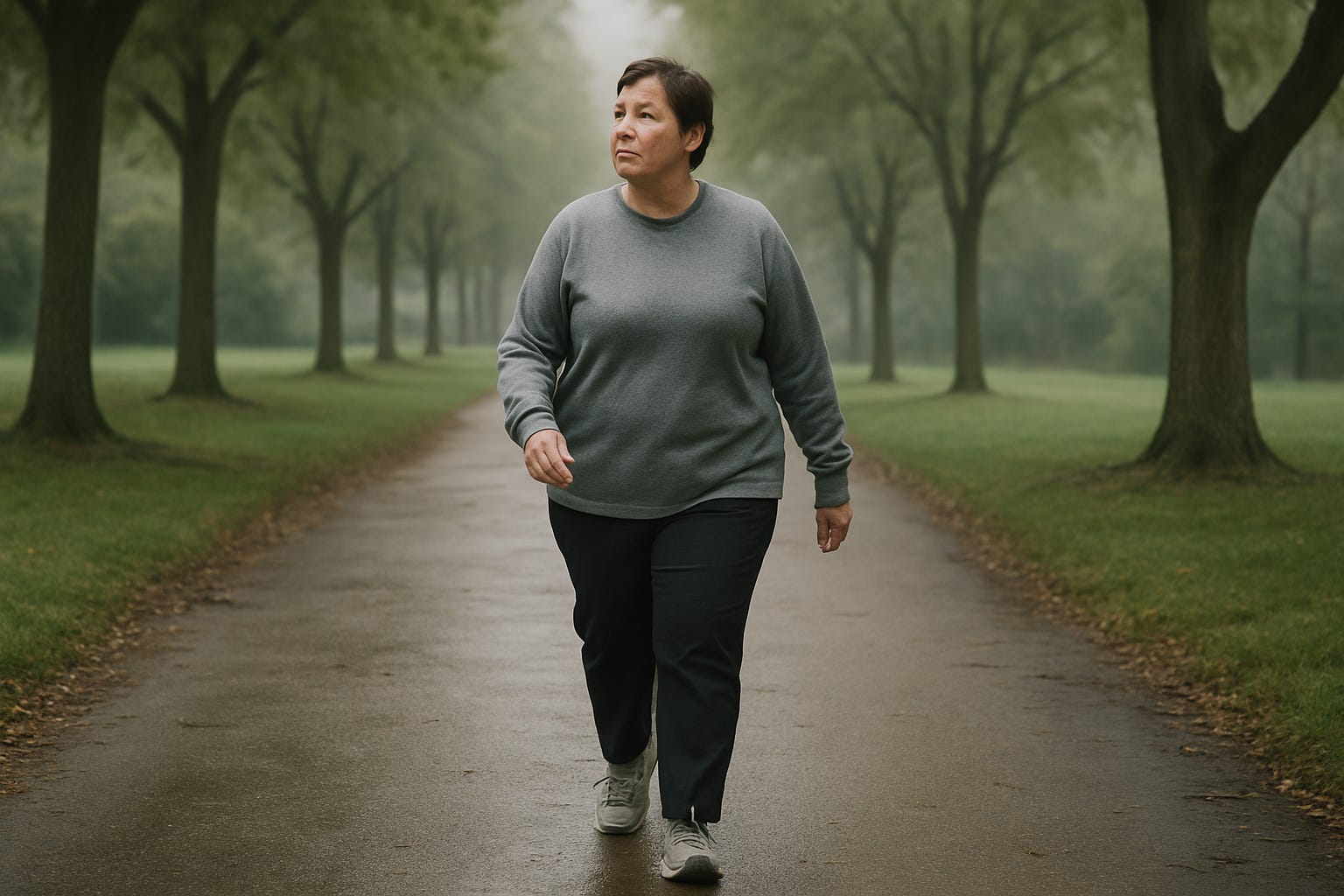
Somewhere in your house right now is a longevity intervention that costs nothing, requires zero prescriptions, and has more data behind it than most supplements sold today combined. It’s not NAD+. It’s not a peptide. It’s not even fancy. 🚶 It’s walking.
I know, I know. You clicked on an article promising a “hack” and got handed the most boring answer in the history of health journalism. But stick with me, because the research behind this one is wild, and the story of how we found out starts in 1960, with a guy who thought heart disease was basically a coin flip.
The 65-year study that started it all
In 1960, an epidemiologist named Ralph Paffenbarger began tracking the health habits of over 50,000 college alumni from Harvard and the University of Pennsylvania. He sent them questionnaires. He asked about their exercise. He waited. And kept waiting. For decades.
By the time results started rolling in, a clear pattern had emerged: men who walked more, climbed more stairs, and played more sports lived measurably longer than their sedentary classmates. A landmark 1986 paper in the New England Journal of Medicine found that alumni burning 2,000 or more calories a week through activity like walking had death rates one quarter to one third lower than their less active peers. Not a little lower. A third lower. 📉
The Harvard Alumni Health Study ran from 1960 through the early 2000s, over 40 years of continuous follow-up
It tracked more than 50,000 participants, one of the largest cohorts of its kind
By 2001, researchers found that exercising and quitting smoking added almost four years of life, even in alumni who started in their 70s and 80s
The activity that moved the needle most wasn’t marathon training. It was brisk walking, golf, tennis, gardening, and swimming
What gets me about this study isn’t just the size of it. It’s the patience. Paffenbarger kept publishing findings from this cohort until his own death in 2007, and researchers like I-Min Lee carried the torch afterward. That’s the kind of “n of 50,000 over half a century” evidence that no influencer-backed supplement stack will ever have. Have you ever taken something because a study said so, only to find out later the study had 40 participants and ran for six weeks? Yeah. This isn’t that. 🔬
Walking isn’t just old news, it’s confirmed news
Here’s where it gets interesting: this isn’t a relic from the 1980s that modern science quietly abandoned. It got a massive, current-day confirmation in 2025.
Researchers led by Professor Melody Ding at the University of Sydney pooled data from 57 studies spanning over 160,000 adults across the US, UK, Japan, Australia, and Europe, then published the results in The Lancet Public Health. The takeaway: walking about 7,000 steps a day, compared to a sedentary baseline of 2,000 steps, was linked to a 47% lower risk of dying from any cause. Not 7% or 12%. Forty-seven. 🚀
The same analysis found reductions across a startling range of conditions:
25% lower risk of cardiovascular disease
38% lower risk of dementia
22% lower risk of depression
14% lower risk of type 2 diabetes
28% lower risk of falls
And here’s the part I actually love: the old “10,000 steps a day” number, which most of us assumed came from a peer-reviewed lab, actually traces back to a 1960s Japanese pedometer marketing campaign. It was never really evidence-based. The 2025 Lancet analysis found that pushing past 7,000 to hit 10,000 only added about one extra percentage point of benefit. You’re not leaving much on the table by aiming lower. Diminishing returns, real talk. 💡
Want to know something else? Even modest movement counts. The research found that going from 2,000 to just 4,000 steps a day already produced meaningful health improvements. You don’t need to be a step-count zealot to benefit here.
Why walking outperforms most of what’s in your supplement cabinet
I say this as someone who has genuinely tried more biohacking gadgets than I’d like to admit. Cold plunges, continuous glucose monitors, the works. And I still come back to this: walking has a level of evidence that almost nothing sold at a “longevity clinic” can match. 🧬
Compare the categories honestly:
Calorie restriction and intermittent fasting: shown to extend lifespan in mice, but researchers still don’t know if the effect holds up in humans
Anti-aging supplement stacks: mostly unregulated, rarely tested in large human trials, and often sold on the strength of a testimonial rather than a dataset
Stem cell and oxygen therapies: described by MIT AgeLab director Joseph Coughlin as “experimental at best”
Brisk walking: 65 years of continuous cohort data, a 2025 meta-analysis of 160,000 people, and a mechanism (better cardiovascular function, lower inflammation, improved insulin sensitivity) that researchers actually understand
Roger Fielding, a senior scientist at the USDA Human Nutrition Research Center on Aging at Tufts, put it plainly: it’s the exercise itself, not the gym membership or the fancy biometric tracker, that drives the benefit. You can get the same results walking around your neighborhood as someone paying $200 a month for a trainer to watch you do it. That’s not a knock on trainers. It’s just math. 📈
Here’s a small confession: I used to be skeptical that something this simple could compete with the cooler, more expensive stuff. It felt almost anticlimactic. But the data doesn’t care about my aesthetic preferences, and neither should yours.
How to actually use this (without turning it into a chore)
The good news is you don’t need a plan so complicated it needs its own spreadsheet. A few practical starting points:
Track your baseline first. Wear your phone or a cheap pedometer for three days without changing anything, just to see where you actually land
Add, don’t overhaul. If you’re at 3,000 steps a day, aim for 5,000 before you aim for 10,000
Stack it onto habits you already have. Walk during phone calls, park farther away, take the stairs when you can
Prioritize consistency over intensity. The research consistently shows daily movement beats occasional heroic gym sessions
Don’t stress about hitting a magic number every single day. The dose-response curve is gradual, not a cliff
If you’ve been sitting on a Blue Zones-style overhaul of your entire lifestyle, waiting for the “perfect” plan, consider skipping that and just walking to the end of your block today. This connects to something we covered in 7 Longevity Lessons from Blue Zones You Can Apply Today, where movement built into daily life, not gym time, turned out to be one of the biggest common threads among the world’s longest-lived populations.
And if walking already has your attention and you’re wondering what else is worth your money (and what isn’t), our breakdown of 7 Affordable Longevity Technologies You Can Start Using Today is a good next stop; it’s built on the same principle that the cheap stuff often outperforms the expensive stuff.
So here’s my actual question for you: what’s stopping you from taking a 20-minute walk today, right now, before you do anything else on your longevity to-do list? 🌱