

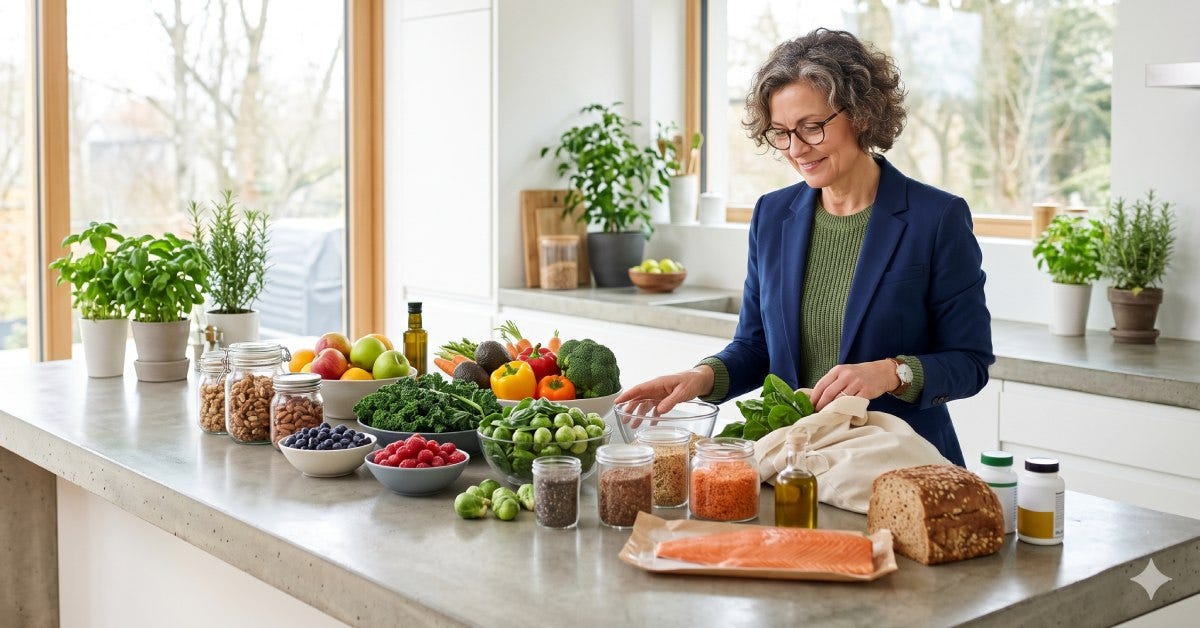
Walk into the home of a serious longevity researcher, open the fridge, and you’ll probably find the same dozen things. Not $400 peptide powders. Not exotic roots flown in from the Andes. Regular food — chosen with unusual precision. That’s the part most of us miss: it’s not that longevity scientists eat weird things, it’s that they never skip the right ordinary ones.
A 2025 study published in Nature Medicine that analyzed over 100,000 adults found that a plant-forward diet rich in whole grains, fruits, vegetables, and nuts was linked to significantly better aging outcomes. Meanwhile, a 2024 study in the American Journal of Clinical Nutrition concluded that Americans have some of the greatest room for improvement globally — because we eat too much processed meat and too little of exactly the foods on this list.
So what actually makes the cart? I’ve cross-referenced what researchers like Dr. David Sinclair at Harvard, Dr. Peter Attia, and Dr. Rhonda Patrick consistently eat and recommend, stacked it against the published science, and arrived at 12 items. Some are obvious. A couple will surprise you. All of them are at your local grocery store right now.
The berry that fights brain aging while you eat breakfast
Blueberries 🫐 are probably the most researched food in the longevity space, and for once the hype is actually justified. Their deep color comes from anthocyanins — a class of polyphenols that cross the blood-brain barrier and directly protect neurons from oxidative damage. Regular consumption is linked to slowing cognitive decline by up to 2.5 years, according to researchers at Longevity Direct. A report in the journal Nutrition found that adults with the highest polyphenol intake had meaningfully lower odds of all-cause mortality.
The practical case is even simpler: one cup a day in oatmeal, yogurt, or a smoothie, and you’re doing real work. Frozen blueberries retain their anthocyanins just fine — probably better than the bruised, half-sad fresh ones that sat on a truck for four days.
What else makes the berry shelf worth your time?
Strawberries contain fisetin, a compound David Sinclair has cited for its senolytic properties (it selectively clears out aging “zombie” cells)
Blackberries and raspberries add unique antioxidant profiles that blueberries alone can’t provide
Eating a variety of berries, rather than just one type, is linked to up to a 20% reduction in chronic disease risk
Drop a handful of mixed frozen berries into whatever you’re already eating. That’s the whole protocol for this one. 🍓
The oil your arteries actually want
Good oils are having a moment, and extra virgin olive oil (EVOO) absolutely deserves it. The science here is among the strongest in nutritional research. A 2024 review identified two compounds in EVOO that do the heavy lifting: hydroxytyrosol, which neutralizes free radicals and reduces oxidative damage to blood vessel walls, and oleocanthal, which inhibits the same inflammatory pathways as ibuprofen. Not in some vague hand-wavy way — mechanistically, same pathway. 🫒
The landmark PREDIMED trial, which followed thousands of people over years, found consistent cardiovascular protection with regular EVOO use. A 2025 systematic review confirmed improvements in oxidative stress markers, inflammatory biomarkers, and metabolic parameters in participants who consumed virgin olive oil regularly.
There’s a catch the label won’t tell you: most olive oils on American supermarket shelves have already lost up to 40% of their phenolic potency due to light, heat, and age. You want:
“Extra virgin” specifically — not “pure olive oil,” which is a refined product with almost no polyphenols
A harvest date on the bottle, not just a “best by” date — within 18 months of harvest is ideal
A slightly bitter, peppery finish when you taste it raw — that burn is oleocanthal working
Two tablespoons a day as a finishing oil or in a dressing. Simple. 🫙
The vegetable that acts like a cellular cleanup crew
This is the one that surprises people. Broccoli sprouts — not mature broccoli, but the sprouts — contain anywhere from 20 to 100 times more sulforaphane than the adult vegetable. Sulforaphane is the compound that activates the Nrf2 pathway, sometimes called the body’s master switch for antioxidant and anti-inflammatory defense. One molecule of sulforaphane triggers the production of thousands of protective enzyme molecules. 🥦
A 2025 preprint on bioRxiv found that sulforaphane extends lifespan in model organisms by slowing what researchers call the “transcriptional aging clock.” Dr. Rhonda Patrick has specifically called out broccoli sprouts as a weekly non-negotiable — and she also discovered that freezing them increases their sulforaphane availability by nearly twofold before eating.
If you can’t find sprouts, mature broccoli still earns its place. Dr. Mark Hyman, a physician and author focused on functional medicine, puts it bluntly: “There’s really no upper limit on how many cruciferous vegetables you can eat.” He particularly highlights their folate content, which is critical for DNA methylation — the process that switches longevity genes on and off. That’s not a metaphor. That’s how it works.
Cruciferous vegetables you should rotate through:
Broccoli sprouts (highest sulforaphane concentration by far)
Mature broccoli, kale, Brussels sprouts, and cabbage
Cauliflower, which most people underestimate
Do you eat cruciferous vegetables at least four times a week? If not, it’s worth asking why — because the evidence for this category is remarkably consistent. 🌿
Protein from the sea, without the mercury problem
Sardines are the longevity food that nobody wants to eat and everybody should. A single can, roughly 3.8 ounces, delivers 25% of your daily vitamin D, a meaningful hit of calcium, and some of the cleanest omega-3 fatty acids available — EPA and DHA, the forms the brain and heart actually use directly. Because sardines are small and short-lived, they accumulate almost no mercury. They’re also cheap. 🐟
Dr. Mark Hyman puts it plainly: eating fatty fish twice a week is sufficient to meaningfully reduce your risk of heart attack, arrhythmia, stroke, high blood pressure, and elevated triglycerides. Dr. Peter Attia consistently recommends high-dose EPA and DHA, noting in Outlive that unless patients eat a lot of fatty fish, they almost always need to supplement. Wild salmon, mackerel, anchovies, and herring work equally well. The omega-3 connection to longevity is through inflammation — these fats reduce systemic chronic inflammation, which researchers increasingly see as the underlying mechanism of virtually all age-related disease.
What to look for at the fish counter or canned aisle:
Sardines in olive oil (double win) or water — avoid the ones in soybean oil
Wild salmon over farmed when possible for a higher omega-3 to omega-6 ratio
At least two servings of fatty fish per week as a minimum target, not a ceiling
Walnuts, lentils, and the nuts-and-legumes pairing that actually extends life
These two earn a shared section because the evidence for eating them together — as part of a plant-forward protein strategy — is stronger than either alone. Walnuts 🌰 are the only nut with a meaningful source of plant-based omega-3s (ALA), in addition to vitamin E, magnesium, and compounds that support heart and brain health. A study published in Nutrients in 2021 linked regular walnut consumption with lower all-cause mortality and extended life expectancy in U.S. adults.
Dr. Florence Comite, a physician specializing in precision medicine, singles out walnuts as a favorite specifically because they bridge the gap between nut nutrition and the omega-3 benefits you’d otherwise only get from fatty fish.
Lentils bring the fiber half of the equation. Blue Zone populations eat roughly four times as many legumes as Americans — green beans, fava beans, lentils, and soybeans appear in almost every long-lived community studied. A meta-analysis in the European Journal of Epidemiology found that people who ate more plant protein were significantly less likely to die early, a finding that did not replicate for protein from meat. Both soluble and insoluble fiber from legumes improve cholesterol and blood sugar, and feed the gut microbiome in ways researchers are still figuring out but increasingly believe matter enormously.
A handful of walnuts (about 1 ounce) as a daily snack covers the basics
Lentils cook in 20 minutes with no soaking required — the fastest legume in the category
Canned chickpeas or black beans work fine when you want something even faster
The fermented duo your gut microbiome is waiting for
The gut-longevity connection has moved from fringe hypothesis to mainstream research priority over the past five years, and plain Greek yogurt sits at the center of the accessible end of that story. Dr. Comite recommends it specifically for its protein, calcium, magnesium, and — interestingly — GABA, a neurotransmitter that reduces stress and improves sleep. Greek yogurt contains more GABA than regular yogurt, which is a genuinely underappreciated fact. 🥛
Plain is the critical word here. Flavored yogurts are, in many cases, dessert wearing a wellness costume. The probiotic bacteria that actually support immune function and inflammation control don’t care about the strawberry swirl.
If you want to level up the gut health angle:
Add kefir (a fermented milk drink) to your rotation — it contains a broader range of probiotic strains than yogurt
Look for yogurts that list live active cultures on the label
Miso, kimchi, or sauerkraut a few times a week add another dimension entirely
The research on the gut microbiome and aging is still developing fast — worth staying current on. Our piece on 7 longevity lessons from Blue Zones touches on fermented foods as a thread running through most long-lived communities.
Garlic and green tea: the cheapest functional foods on the shelf
Garlic 🧄 contains allicin, a sulfur compound that forms when you crush or chop a raw clove — cooking immediately reduces it significantly. The anti-inflammatory and cardiovascular effects of garlic are among the most consistently replicated in nutritional research: regular consumption is associated with reduced blood pressure, improved cholesterol profiles, and antimicrobial properties. The catch is the timing: crush it, let it sit for ten minutes, then add to your dish. That wait activates the enzyme that generates allicin.
Green tea pairs well with this section because both are cheap, globally consumed, and backed by decades of solid research rather than recent hype. Green tea’s primary active compound, EGCG (epigallocatechin gallate), has been shown to support autophagy — the same cellular recycling process that David Sinclair describes as central to longevity biology. It’s also the most widely studied polyphenol for brain health. 🍵
Populations in Japan, where green tea consumption is highest, have among the longest life expectancies in the world. That’s correlation, not proof — but when the mechanism, the epidemiology, and the experimental data all point the same direction, the picture gets harder to ignore.
For daily practice:
Two to four cups of green tea daily is the range used in most studies showing benefit
Matcha delivers higher concentrations of EGCG than steeped green tea
For garlic, one to two cloves daily, crushed and rested before cooking, is a reasonable target
Dark chocolate, leafy greens, and the items that make this list livable
Any grocery list that asks you to eat nothing but fish and sprouts deserves to be ignored. So: dark chocolate (70% cocoa or higher) belongs here, and the science backs it up rather than apologizes for it. It contains flavanols that support heart health and cognitive function, and Dr. Comite makes the counterintuitive point that dark chocolate actually has more antioxidants than blueberries. A reasonable amount — a square or two daily — is associated with reduced blood pressure and improved cerebral blood flow. 🍫
Leafy greens are the last entry, and possibly the most important one to actually do every single day. Studies show that eating one cup of leafy greens daily can preserve brain function equivalent to being 11 years younger, according to research from Rush University. Spinach, kale, arugula, and Swiss chard deliver lutein, vitamin K, folate, and nitrates — a nutrient combination that few other foods can match.
The full list for reference:
🫐 Blueberries
🫒 Extra virgin olive oil
🥦 Broccoli sprouts (or mature broccoli)
🐟 Sardines or wild salmon
🌰 Walnuts
Lentils or legumes
Plain Greek yogurt
🧄 Garlic
🍵 Green tea
Dark chocolate (70%+)
Leafy greens (kale, spinach, arugula)
Mixed berries (rotation beyond blueberries)
None of this is exotic. All of it is consistent. The longevity researchers who have built careers studying aging eat this way not as a performance but because the evidence eventually made it the obvious choice. And as we’ve covered in our look at 5 longevity myths even smart people still believe, the most powerful interventions are often the most boring — which is exactly what makes them work.
If you had to start with just three items from this list tomorrow, which three would you actually add to your cart? That’s probably the more useful question than trying to overhaul everything at once.