

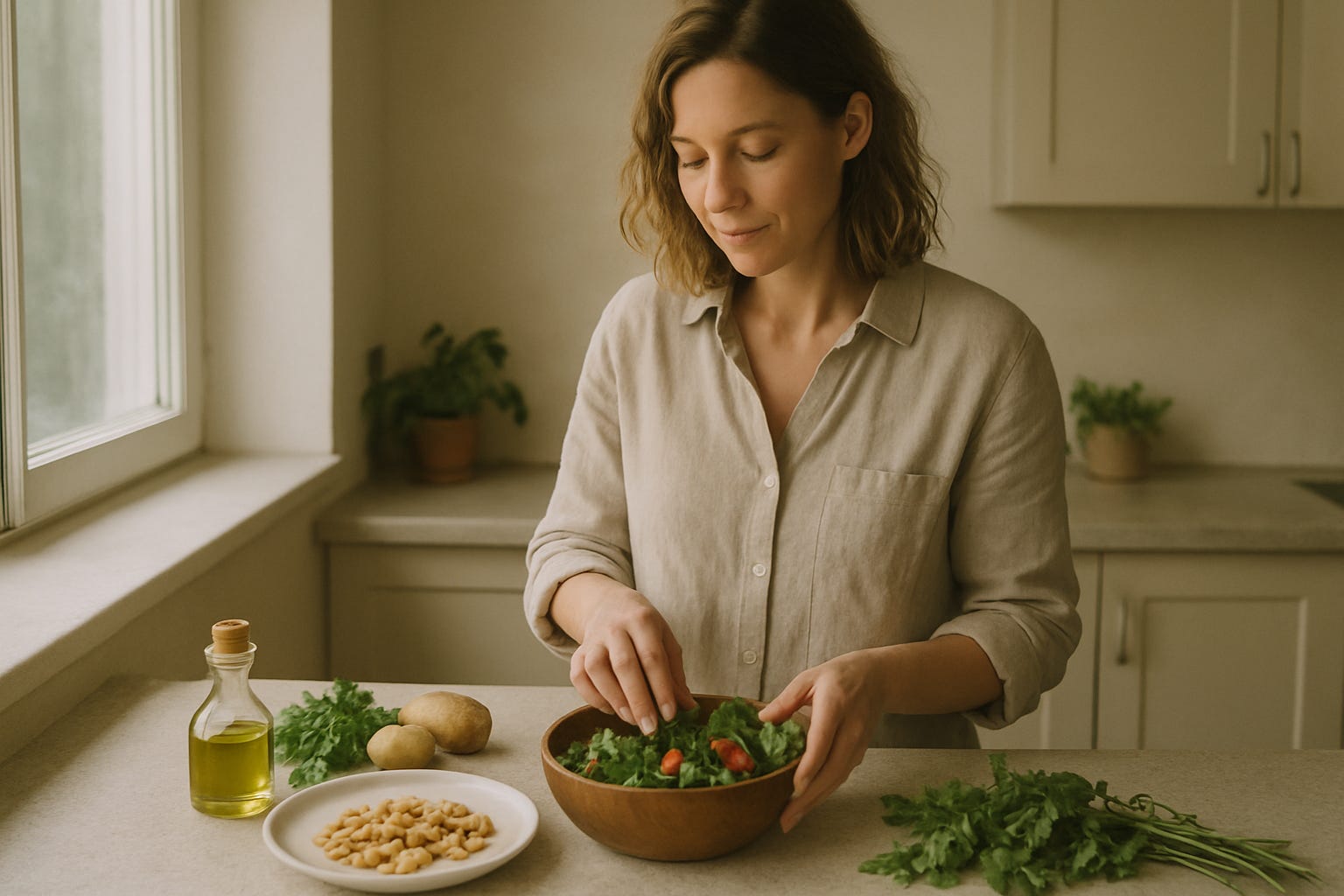
There’s a version of healthy eating that requires a dehydrator, $90 in supplements, and the patience of someone who genuinely enjoys reading ingredient labels. Then there’s the version that centenarians in Sardinia, Okinawa, and Ikaria actually practice, which involves beans, olive oil, and a handful of whatever vegetables didn’t die in the fridge. One of these approaches has a mountain of longevity data behind it. The other one sells more podcasts.
The concept of a “longevity plate” is not some branded protocol. It’s a useful mental model: a single meal assembled from the categories of food that consistently show up in both the Blue Zones research and the latest molecular biology. You don’t need to count anything. You don’t need an app. And yes, you can build it in under ten minutes, which is especially good news because doing it consistently, meal after meal, day after day, is the part that actually matters.
Here’s how it works.
The plate architecture: what goes where and why 🧬
Think of the longevity plate in three zones, and let the ratios drive themselves naturally:
Half the plate: vegetables and leafy greens. Not as a punishment, but as the structural base. Spinach, kale, arugula, broccoli, zucchini, whatever’s in season. Frozen is genuinely fine.
One quarter: legumes or whole grains. Lentils, black beans, chickpeas, farro, quinoa, or a mix. This is where most of the protein and fiber comes from.
One quarter: optional protein. A piece of salmon, a soft-boiled egg, or nothing — the legumes already have you covered.
According to a re-analysis of longevity nutrition data, this ratio naturally delivers the ideal longevity nutrient profile: half the plate filled with vegetables, one quarter legumes or whole grains, and one quarter optional fish or fermented dairy. It’s also the actual plate pattern of populations with the highest concentrations of people who live past 90.
The finishing touch is olive oil, and this is where a lot of people are too cautious. The research here is striking. In Ikaria, Greece, researchers found that middle-aged people who consumed about six tablespoons of olive oil daily seemed to cut their risk of dying in half compared to those who used less. Six tablespoons is a lot. Most people drizzle a cautious teaspoon and call it healthy. I’d argue this is one of the cheapest upgrades you can make to any meal.
Frank Hu, Professor of Nutrition and Epidemiology at Harvard T.H. Chan School of Public Health, is consistent in his position: diets high in unsaturated fats like olive oil have been linked to lower mortality, while those high in saturated fats may contribute to premature mortality.
This is worth thinking about for a moment: a plate that’s essentially vegetables, legumes, and olive oil isn’t a diet. It’s a framework — and the ten-minute version of it isn’t a compromise. It’s how people with long lives actually eat.
The five ingredients you should always have on hand 🌱
If you have to build this from scratch every time you’re hungry, you won’t. The real secret to eating this way consistently is that your kitchen makes it easy. This is the shopping list that does most of the work:
Canned or dried lentils and chickpeas: The workhorse of the longevity plate. According to Dietitian Sarah Doig’s bean-based longevity research, a half-cup of beans daily is standard in Blue Zones communities — delivering plant protein, fiber, and heart-friendly minerals. Canned works perfectly. Rinse and you’re done.
Extra-virgin olive oil: Buy the good stuff. It has measurably higher levels of the anti-inflammatory compounds hydroxytyrosol and oleocanthal that cheaper versions strip out during processing.
Frozen leafy greens: Spinach, kale, chard. Nutritionally equivalent to fresh, zero waste, ready in two minutes.
Whole grains in bulk: Farro, brown rice, or quinoa cooked in batches once or twice a week. Takes 20 minutes once, then just reheats.
A handful of walnuts or mixed nuts: Not a garnish. According to the Adventist Health Study-2, which tracked 100,000 people, those who ate a daily ounce of tree nuts lived roughly two years longer on average.
The point of this list is that every item on it has a documented, replicated relationship with longer life. None of it is exotic. All of it is available in any supermarket, often at prices that compare favorably to the packaged stuff they sell in the “health” aisle.
What does your kitchen look like right now? If you opened your fridge and had to build a longevity plate in the next ten minutes, could you? That’s actually a useful diagnostic.
The protein question: how much actually belongs on your plate 🔬
Protein is where the longevity conversation gets complicated, and I think most advice oversimplifies it in one direction or the other.
Here’s what the data actually shows. The standard RDA of 0.36 grams per pound of body weight is probably too low for people over 40, because aging muscles develop what researchers call anabolic resistance — a reduced efficiency at converting dietary protein into muscle tissue. Research published in a 2024 review in Nutrients and data from PubMed Central suggests the standard recommended allowance is likely too low for optimal aging, with experts now recommending 0.6 to 0.9 grams per pound to counteract muscle loss. Muscle is a longevity organ in a way most people don’t fully appreciate: losing it accelerates metabolic disease, frailty, and dependency.
At the same time, the Blue Zones data tells us something equally clear. People who live the longest aren’t eating steak three times a day. The longevity research from populations like Sardinia and Okinawa consistently shows moderate animal protein, used almost as a flavoring rather than a centerpiece. Valter Longo’s longevity diet framework, developed at the USC Longevity Institute, leans heavily plant-forward with fish as the primary animal protein for people over 65.
The practical resolution:
Prioritize plant protein first (legumes, lentils, tempeh, edamame)
Add fatty fish two to three times a week
Distribute protein across meals rather than loading it all into one
Pair whatever protein you eat with resistance training, or the protein arithmetic changes dramatically
This isn’t a war between plant protein and animal protein. It’s a question of proportions — and the longevity plate defaults to getting most protein from plants with fish appearing a few times a week.
What to actually avoid (the food category that accelerates aging fastest) ⚡
Most longevity nutrition content focuses entirely on what to add. This section is about what the data says to cut back, because the evidence here is stark enough to earn a mention.
Ultra-processed foods are the clearest, most consistently documented dietary driver of accelerated biological aging. Researchers at Monash University published findings showing that for every 10% increase in ultra-processed food consumption, biological age advanced by 2.4 months relative to chronological age — and the predictions show a nearly 2% increased risk of mortality per 10% increment in intake. That’s not a theoretical risk. That’s a measurable shift in how old your cells look and act.
A 2024 meta-analysis in The BMJ pooled data from 45 studies and over 9.9 million participants and found high ultra-processed food intake was associated with a 32% higher risk of all-cause mortality and a 40% higher risk of cardiovascular disease-related death, independent of total caloric intake and body weight. The mechanism isn’t just about empty calories — the additives, emulsifiers, and processing byproducts appear to drive inflammation and disrupt the gut microbiome in ways that accelerate cellular aging.
The foods in this category include:
Packaged snacks, chips, and crackers
Ready-to-eat meals with long ingredient lists
Processed meats (sausages, hot dogs, deli meat eaten daily)
Sweetened beverages, including most flavored waters and “health” drinks
Most breakfast cereals marketed as healthy
None of this means you can never eat these things. It means they shouldn’t be the structural center of your meals — which is exactly what the longevity plate replaces them with.
For more on which foods longevity experts eat every week and which they actively avoid, that rundown is worth bookmarking alongside this one.
A real 10-minute longevity plate, step by step 🥗
Let’s get specific, because “eat more vegetables” is not a recipe.
Here’s the fastest version that hits all the markers:
Warm the base (2 minutes): Sauté a large handful of frozen spinach in a pan with two tablespoons of extra-virgin olive oil and one clove of garlic. Don’t be delicate with the olive oil. Add salt.
Add legumes (1 minute): Drain and rinse half a can of chickpeas or lentils. Add directly to the pan. Stir.
Add grains (0 minutes if pre-cooked): Scoop pre-cooked farro or brown rice from the fridge. Microwave 90 seconds while the greens finish.
Optional protein (3 minutes): Pan-sear a small piece of salmon, or crack two eggs into the pan.
Finish (1 minute): Another drizzle of olive oil over everything. A squeeze of lemon. A small handful of walnuts on top.
Total time: under ten minutes if your grains are pre-cooked. The practical biohacking fundamentals that show up in longevity research again and again are almost always this simple — not because simplicity is a shortcut, but because it’s what people can actually sustain over decades.
A 2025 study published in Nature Medicine analyzed over 100,000 adults and found that adhering to a plant-forward diet rich in whole grains, fruits, vegetables, and nuts was associated with significantly better aging outcomes. Not better outcomes if you followed it perfectly. Better outcomes if you followed it at all, consistently.
The question worth sitting with: how many of your current meals share most of the structure of that plate above? Not all of them. Not even most. But how many? That number, repeated daily, is probably the most direct dietary lever you have on how you’ll feel at 70.